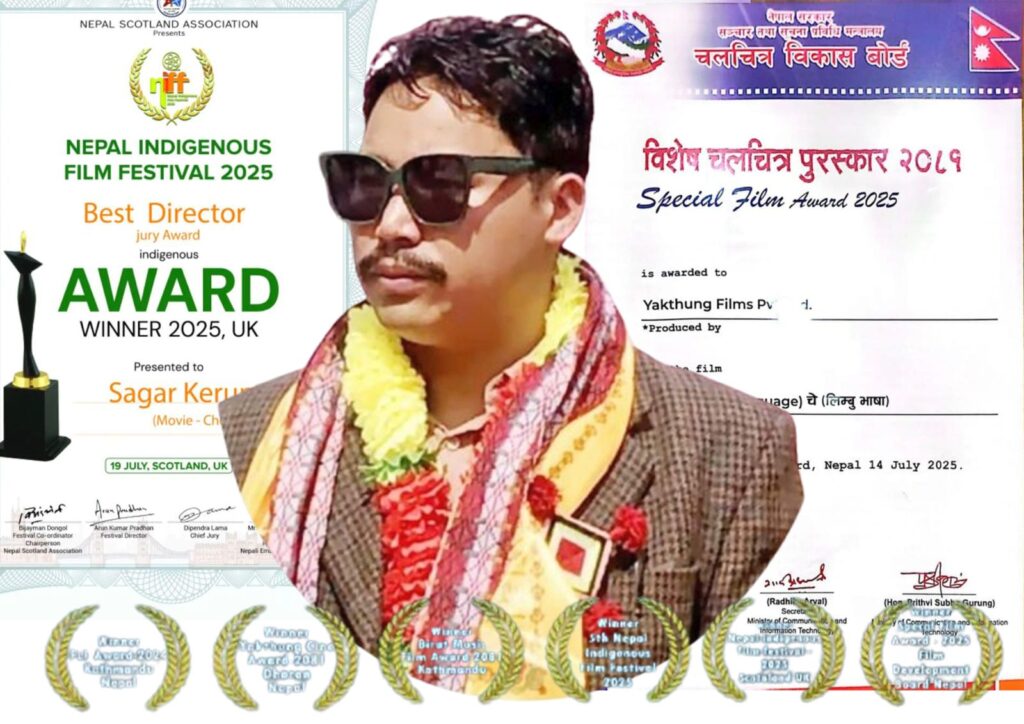
Panchthar – Six important literary works by renowned Yakthung intellectual and multi-dimensional creator Sagar Kerung have been released together. The books were officially launched during a special ceremony organized by the Yakthung Academy Nepal on Saturday, Baisakh 26, held in Phidim, Panchthar.
Most of the works published in 2082 BS are based on subjects taught in higher education levels (B.A. and M.A.) in the Limbu language. This milestone is considered a new dimension in the development of Limbu language, literature, and academic resources.
The released works include a children’s song collection “Phung”, “Yakthung Pang-Pangwaila” (Limbu folk drama), a song collection “Silamsakma”, “Munchait Henzila Muksi Nu Parikha” (Film—Definition, Elements, and Types), a short story collection “Thang”, and “Yakthung Abu Samlo – Henzila Muksi Nu Parikha” (Limbu Children’s Song—Definition, Elements, and Types).
These publications were produced with the collaboration of Kirat Yakthung Chumlung chapters from Portugal, Malta, Germany, Romania, and Belgium, along with Yakthung Munchait Chok Sayang Sikkim, and contributors including Chandrakala Samba, Devman Angbo, Sangita Sering Chongbang, Kamala Kerung, and Badri Prasad Senehang.
Previously, Sagar Kerung has already authored numerous plays, ideological writings, and literary works in both Limbu and Nepali languages. His notable works include “Dosro Nagarik,” “Pasibhajyang,” “Sakthim,” “Sunauli-Rupaiuli,” “Saimundri,” “Numahangma,” “Kemaba Laje,” “Saksa Nu Penyuk,” and “Tiyaha,” among others.
Recognized as the first person from Nepal to obtain higher education in the Limbu language, Kerung has been actively engaged in theatre, cinema, and literature for nearly two decades. He has continuously contributed to the preservation and promotion of the Limbu language, culture, and identity.
His newly released works are being regarded as a historic achievement that expands the academic and ideological foundation of Limbu literature while integrating literature, cinema, and theatre into a unified creative movement.
Stakeholders have stated that this achievement not only strengthens Limbu literature but also energizes the broader Indigenous literary movement, serving as an inspiring example for the new generation. It is expected to further increase interest and engagement in mother-tongue literature.
Advertisement